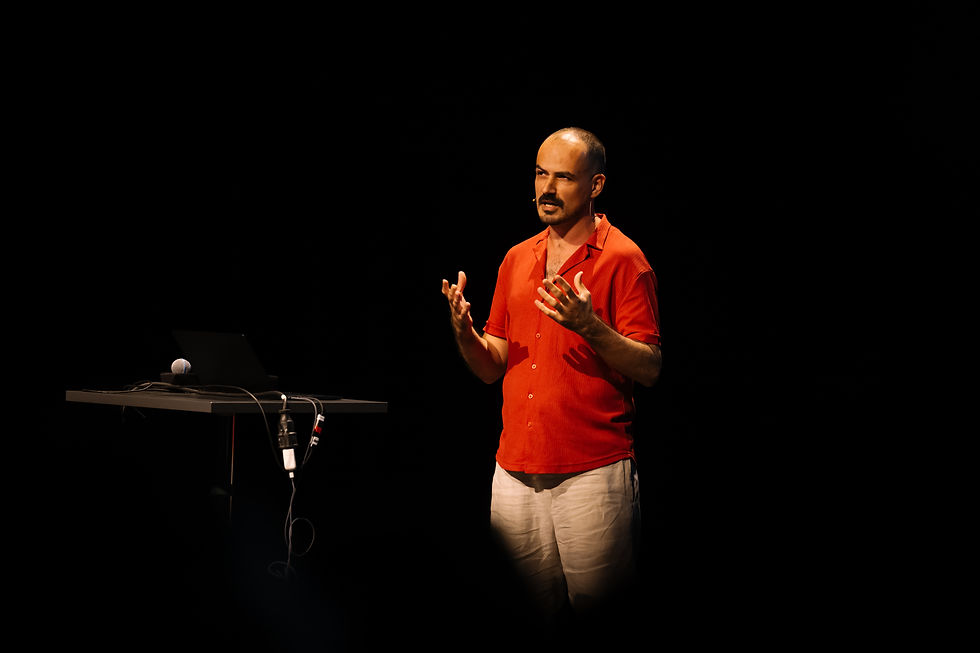
İstanbul Queer Museum

A press conference for an exhibition about gay tourism in a fictional museum.
Performance, 20', 2024
Writer and director
Nadir Sönmez
Performers
Nadir Sönmez
İnci Sefa Cingöz
Selin Hasar
Selected Performances
SAHA Studio, 2024
İstanbul Fringe Festival, 2025

Curator: This exhibition emerged as a result of you revisiting your sixteen years of adult sexual life. You see your sexuality as a cultural value for both our country and world art history. Sometimes, you make love to Hollywood producers in crisp hotel sheets, and sometimes, you get down to business in the bushes by a highway. The socio-economic, geographic, and intellectual spectrum represented by your sexual partners is remarkably wide.
Artist: Their professions are diverse as well. I’m interested in how people’s expertise influences the way they use language and their bodies. When I write a play, I construct characters through professional jargon. My installation The Balance Sheet of My Shyness displays the professions of the men I’ve slept with, represented as tourist badges on a chain.
Curator: You researched academic works on gay tourism and reinterpreted your experiences in light of these studies. The exhibition highlights key themes such as family, class, and loneliness, encompassing different mediums like performance, installation, and video.
Artist: You know how anthropologists go to a site for field research? In this project, I revisit my past experiences as if they were fieldwork while continuing to explore new places, as always.
Curator: When you approach your sex life like an anthropologist, the question arises: Is your body the research tool, or is it the method itself?
Artist: That ambiguity is actually reflected in my project development process. When working on an art piece, I progress along two parallel tracks. On one hand, once an idea comes to me, I document its development in writing. On the other hand, I jot down my feelings and thoughts related to it. You can think of these as two separate files accumulating texts: One that eventually produces the project, and the other serving as a kind of project diary. But in the end, these two files inevitably blend together.
Curator: For example, right now, you’re allowing an audience seated in a theater setup to embark on a video exhibition tour without leaving their seats. Am I understanding this correctly?
Artist: What does it mean to understand correctly? You always express what I want to say better than I do.
Curator: Isn’t that part of a curator’s job? To make artists feel comfortable within the whirlpool of their own minds?
Artist: Sometimes, in today’s world, it feels like the true artists are actually the curators, while the artists themselves are merely their subconscious.
Curator: Don’t flatter me. Tell us about your projects.
Artist: While thinking and reading about performance art, I noticed something: when I experience a performance project as an audience member, I often get bored. But when I read about performance history in a well-written book or encounter a performance’s documentation in an exhibition, with photographs and texts,
I get really excited. When I realized that performance writing excites me more than the performances themselves, I started creating texts for imaginary performance projects.
Curator: Can you give us an example?
Artist: For instance, as part of my exhibition at the Istanbul Queer Museum, I’ll be staging a performance project at the end of this presentation. We’ve arranged for a doctor. I will undergo a live vasectomy in front of the audience. I am a man who exclusively has sex with men. Vasectomy is a birth control procedure. By undergoing a vasectomy despite not engaging in reproductive sex, I strip the procedure of its function and shift focus to the act itself. It’s like writing the text of a performance rather than staging it.